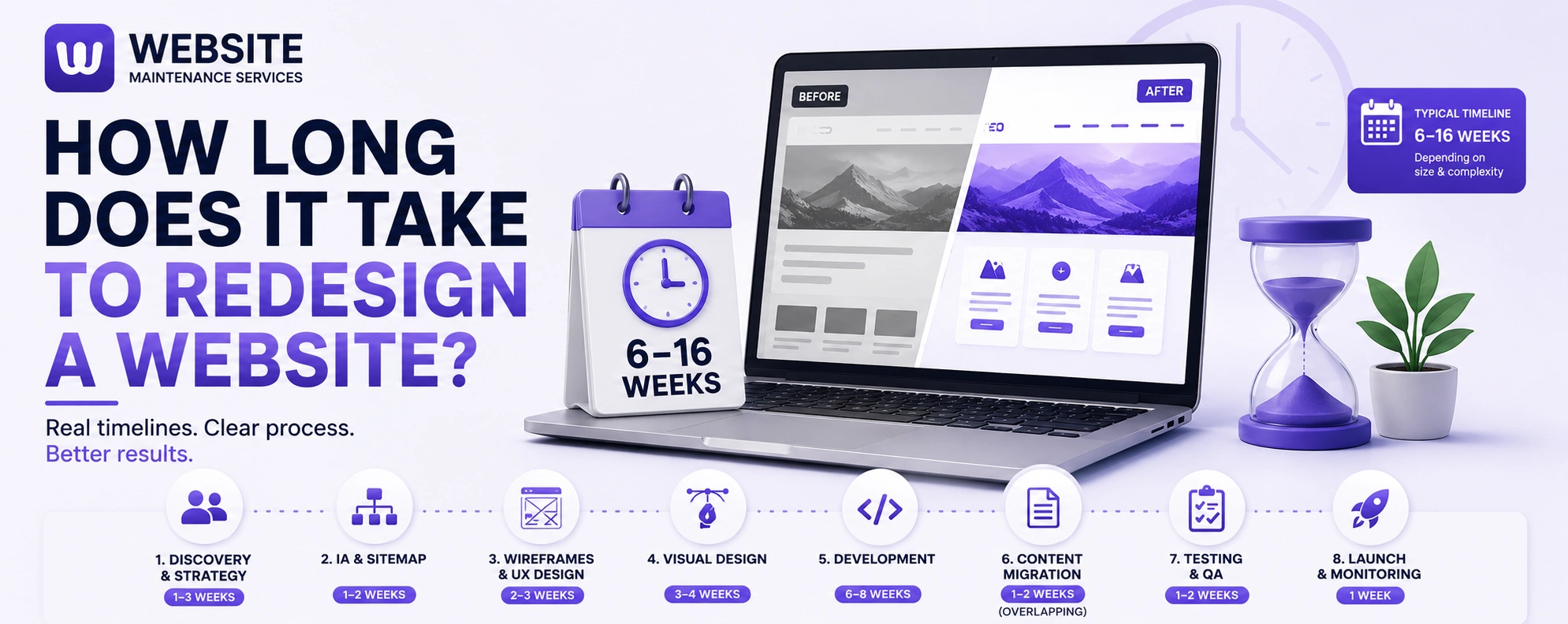
You're planning a redesign and you need a real answer, not "it depends." Maybe there's a trade show, a product launch, or a busy season on the horizon and you need to know: will the new site be ready in time?
Here's the honest answer, based on how these projects actually run.
Quick answer: Most website redesigns take 6 to 16 weeks from kickoff to launch. A small brochure site can be done in 4–6 weeks, a typical small-to-mid business site takes 8–12 weeks, and large or enterprise sites with complex integrations run 4–6 months or more. The single biggest variable isn't the design work — it's how fast content and feedback come from your side.
Below is the realistic breakdown by site size, what happens in each phase, and the specific things that quietly add weeks (most of which have nothing to do with your web team).
By SizeWebsite Redesign Timeline by Site Size
Not all redesigns are the same scope, and the timeline reflects that. Here's what to expect.
Your core pages — Home, About, Services, Contact, maybe a blog — with no ecommerce or custom databases. Achievable with a focused team and a client who provides content and feedback promptly.
The most common scope: multiple service pages, a team or portfolio page, case studies, a blog, and forms with routing logic. The extra time goes into more page templates, more complex navigation, and migrating more content with proper SEO preservation.
Deeper strategy, backend development, heavier content migration, and more thorough testing across a bigger site.
Custom architecture, multiple stakeholders, CMS migration, and integration work push these well past the standard range.
Online stores add complexity at every stage — product catalog migration, payment-gateway testing, inventory integration, and checkout optimization. A simpler WooCommerce store can hit the 8-week mark; a large catalog or custom store stretches to 14–16 weeks.
A crucial warning that every experienced designer will echo: if someone offers to fully redesign your 20-page site in 2–3 weeks, treat it as a red flag. They're either slapping your logo on a cookie-cutter template or cutting corners on strategy, design, or SEO — usually all three. Quality work takes appropriate time.
BreakdownThe Phases of a Website Redesign (and How Long Each Takes)
Understanding where the time goes helps you see why the total is what it is. Here's a typical breakdown for a small-to-mid business redesign.
Discovery and strategy
The foundation. Your team reviews your goals, audience, competitors, and current site data — including Google Analytics and Search Console — to decide what the new site actually needs to do. Skipping this is why so many sites look nice but fail to convert. Locking the scope here is critical, because late scope changes are the number-one cause of delays.
Information architecture and sitemap
Mapping the site structure, navigation, and content hierarchy before any visual design begins.
Wireframing and UX design
Layout planning and user flows — deciding how pages work before deciding how they look.
Visual design
The homepage design comes first because it sets the tone for everything — colors, fonts, spacing, buttons — then interior page templates follow. This phase includes your rounds of feedback and revisions.
Development
Front-end coding, CMS integration, custom functionality, and responsive implementation. Often the longest single phase.
Content migration
Transferring content, populating the CMS, and setting up integrations — with careful SEO preservation so rankings survive the move. Usually overlapping development.
Testing and QA
Cross-browser and real-device testing, mobile checks, accessibility, page-speed, redirect testing, and fixing every bug before customers find them. For redesigns, this must include SEO and redirect validation.
Launch and post-launch
Switching the domain, submitting the new sitemap to Google, and monitoring closely for the first 48–72 hours.
Note that some phases overlap — content migration often runs during development — so the total is less than simply adding every phase together.
DelaysWhy Redesigns Run Late (It's Usually Not the Designer)
Here's the part most agencies won't say plainly: the vast majority of timeline overruns are caused by the client side, not the web team. Knowing these in advance is the best way to keep your project on schedule.
The pattern is clear: an engaged client with content ready and one decision-maker is the difference between a 10-week project and a 20-week one.
Go FasterHow to Speed Up Your Website Redesign
You have more control over the timeline than you might think. To launch faster without sacrificing quality:
Prepare your content first — copy, photos, logo, and brand assets — before design begins. This alone is the biggest time-saver.
Give consolidated feedback within 2–3 business days, and set clear design preferences early using examples or competitor sites so the team gets closer on the first try.
Assign one decision-maker with final say to avoid stakeholder gridlock.
Lock the scope at the start and resist adding features mid-project.
Flag any vacations, board meetings, or busy seasons in the kickoff call so the schedule accounts for them.
What you should not do is compress a real redesign into a rushed two-week sprint. Cutting the strategy, UX, or SEO phases to save time almost always doubles the post-launch fixes and produces a site that looks fine but doesn't drive leads or sales.
Trade-OffTimeline vs Quality: The Trade-Off Worth Understanding
A redesign is a bit like building a house. A shed goes up in a weekend; a custom home takes months. Same builders, same tools — the difference is planning, craftsmanship, and problem-solving. The more strategic value the new site needs to deliver, the more time the process takes, and that time is what separates a website that makes money from an expensive digital business card.
The good news is that a well-run redesign is predictable. With a clear scope, ready content, and responsive collaboration, a small-to-mid business site comfortably launches inside the 8–12 week window — on schedule and built to perform.
Your SitePlanning a Redesign? Get a Realistic Timeline for Your Site
Every site is different, and the honest timeline for yours depends on your page count, features, content readiness, and how quickly decisions get made. A vague "it depends" doesn't help you plan around a launch date — a real estimate does.
Get a free website audit and we'll give you an honest timeline and scope for your specific project — what it needs, how long it'll realistically take, and how to prepare so it launches on schedule. No sales pitch, just a straight answer.
Get a Free Website Audit · See Our Design & Maintenance Services · Talk to Our Team
FAQFrequently Asked Questions
How long does it take to redesign a website?
How long does a small business website redesign take?
Why do website redesigns take so long?
Can a website redesign be done faster?
Is a redesign faster than building a new website?
What's the best time of year to launch a website redesign?
Get a Realistic Timeline for Your Site
Get a free website audit and we'll give you an honest timeline and scope for your specific project — what it needs, how long it'll realistically take, and how to prepare so it launches on schedule. No sales pitch, just a straight answer.