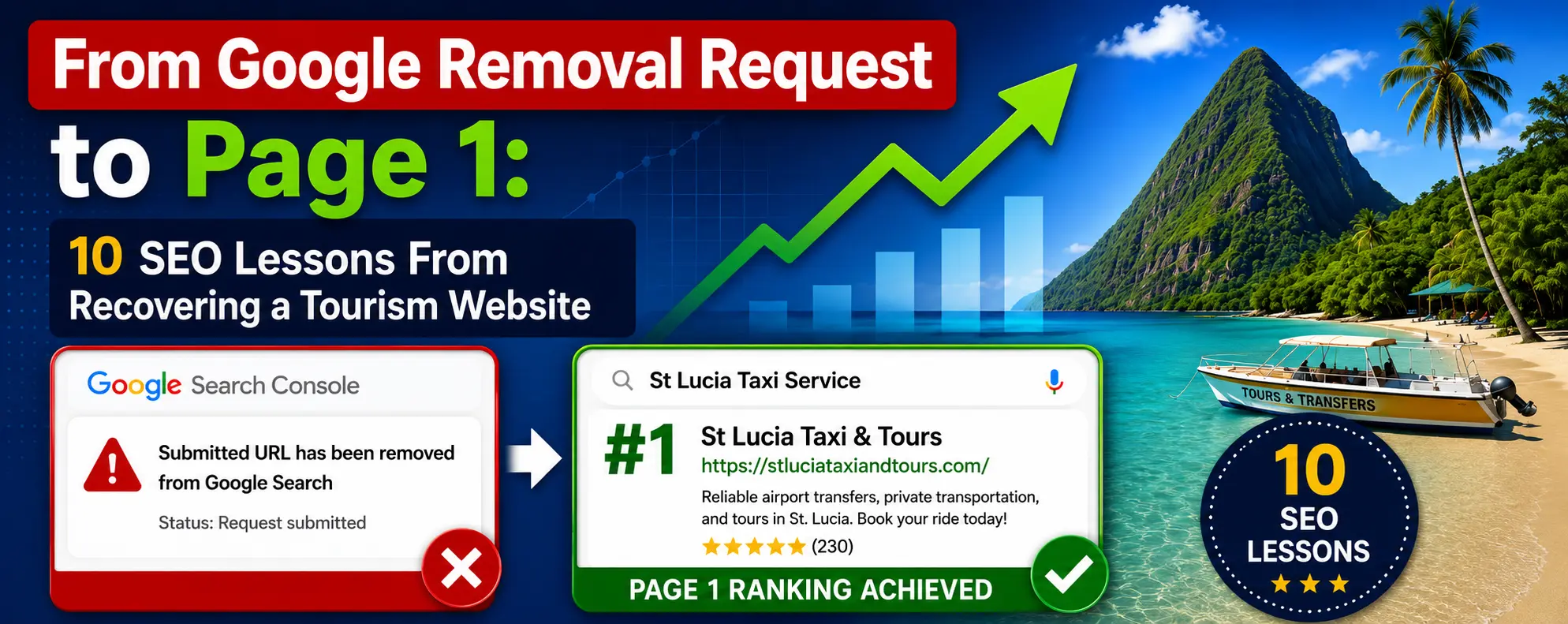
From Google Removal Request to Page 1: 10 SEO Lessons From Recovering a Tourism Website
- Updated: June 20, 2026
- By: Website Maintenance Services
- In: Industry
Most website owners think SEO is all about keywords and backlinks.
After working on a tourism and transportation website in St. Lucia, I learned that real SEO goes far deeper than that.
This project involved a complete website redesign, technical SEO fixes, content optimization, image optimization, internal linking improvements, and recovering from a Google Search Console issue that was quietly holding the entire site back.
The experience reinforced several SEO principles that apply to almost every business website — whether you run a local service company, an eCommerce store, or a national brand.
The short version: The biggest ranking problem on this site wasn't the content, the keywords, or the backlinks. It was a hidden URL removal request buried inside Google Search Console — and once it was cancelled, rankings came back.
Here are the 10 lessons I took away from helping recover and grow this tourism website after a major migration.
The Background
The website belonged to a transportation and tourism company operating in St. Lucia, offering airport transfers, taxi services, private transportation, private tours, hotel transfers, and local tourism experiences.
When we took over, the site had recently gone through major changes and was struggling with several SEO issues. The goal was simple: increase organic visibility, improve rankings, and generate more bookings from Google Search. The reality, as usual, was more complicated.
| # | Lesson | Why It Matters |
|---|---|---|
| 1 | Domain age still matters | Older domains carry trust, links, and history |
| 2 | Authority beats content alone | Trust signals can outrank better writing |
| 3 | Page-specific keywords | Prevents keyword cannibalization |
| 4 | Fewer, stronger pages | One great page beats four weak ones |
| 5 | Beat every competitor | Google needs a reason to rank you higher |
| 6 | Image optimization | Speed, engagement, and image search wins |
| 7 | Technical SEO foundation | Content can't rank if Google can't crawl it |
| 8 | Internal linking & clusters | Helps Google map topical relevance |
| 9 | Maintenance impacts SEO | Neglect leads to ranking losses |
| 10 | The hidden problem | A GSC removal request blocked everything |
Lesson 1: Domain Age Still Matters
One of the first things I noticed was that the domain already had history. Many SEO professionals argue that domain age doesn't matter, and technically they're right — Google doesn't rank a site simply because it's older.
But older websites usually carry real advantages: existing backlinks, brand mentions, historical trust signals, established topical relevance, and previous user engagement data. A well-maintained older domain often has a significant head start over a brand-new one. That's exactly why preserving SEO equity during redesigns and migrations is critical — and why a careful maintenance and migration process matters so much.
Lesson 2: Authority Matters More Than People Realize
Many businesses focus exclusively on content. Content is important — but authority is just as important. A site with average content and strong authority can often outrank a site with excellent content and weak authority.
Authority is built from quality backlinks, brand mentions, trust signals, consistent publishing, user engagement, and a strong technical foundation. It accumulates over time. There is no shortcut.
Lesson 3: Keyword Research Must Be Page-Specific
One of the most common mistakes I see is multiple pages targeting the same keyword, which creates keyword cannibalization. Instead, every page should own one primary topic and one search intent:
| Page | Primary Keyword |
|---|---|
| Homepage | St Lucia Taxi |
| Airport Transfer Page | St Lucia Airport Transfers |
| Private Transportation Page | Private Transportation St Lucia |
| Bird Watching Page | Bird Watching St Lucia |
| Hiking Page | Hiking Tours St Lucia |
When each page owns a specific intent, Google understands exactly which page to rank for each query.
Lesson 4: More Pages Does Not Mean Better Rankings
Many owners believe they need several near-identical pages, such as /st-lucia-taxi/, /taxi-in-st-lucia/, /best-st-lucia-taxi/, and /st-lucia-taxi-service/. In most cases this only creates confusion.
Instead of four weak pages, create one exceptional page that fully covers the topic. Google increasingly rewards comprehensive content that satisfies user intent, and its own guidance emphasizes creating helpful, people-first content rather than content built primarily for search engines.
Lesson 5: Content Must Be Better Than Every Competitor
When optimizing the site, we analyzed competing tourism businesses — their service pages, blog content, FAQs, internal linking, images, and user experience. The goal was to create the best version of every page: more useful information, better FAQs, clearer service explanations, stronger calls-to-action, and improved UX.
If your content isn't better than what's already ranking, Google has little reason to move you above your competitors.
Lesson 6: Image Optimization Is an Underrated Strategy
Images played a bigger role than most people expect. We focused on compressing file sizes, using descriptive filenames, adding optimized alt text, including relevant destination photos, and improving mobile performance.
Images help users understand content, create extra ranking opportunities through image search, and improve engagement metrics. Speed optimization and image compression are core parts of modern website maintenance and performance work — not afterthoughts.
Lesson 7: Technical SEO Can Make or Break a Website
This project reinforced a simple truth: technical SEO is not optional. We audited redirects, canonical tags, XML sitemaps, HTTPS, indexability, crawlability, and internal linking.
Even the best content struggles if technical issues stop Google from understanding the site. For duplicate-URL problems specifically, Google's guidance on consolidating duplicate URLs with canonicals is essential reading. Technical SEO is the foundation everything else depends on.
Lesson 8: Internal Linking and Content Clusters Matter
One of the biggest improvements came from strengthening the relationships between pages. Rather than treating each page as an isolated asset, we connected them through logical internal links:
Homepage → Airport Transfers → Private Transportation → Hotels → Private Tours → Bird Watching → Hiking.
Google uses internal links to discover content and understand relationships between pages, so making links crawlable and descriptive directly helps both crawling and topical relevance. A practical place to start is a structured website maintenance checklist that includes a regular internal-link review.
Lesson 9: Website Maintenance Directly Impacts SEO
Many owners treat SEO and website maintenance as separate services. They aren't. Maintenance directly influences SEO performance.
- Plugin and core updates
- Security monitoring
- Backups
- Performance optimization
- Broken link checks
- Form testing
- Database optimization
Neglecting maintenance leads to security issues, downtime, broken functionality, and ranking losses. If you'd like to see what a structured program looks like in numbers, our website maintenance case study and maintenance plans and costs break it down clearly.
Lesson 10: The Biggest SEO Problem Was Hidden
The most important lesson had nothing to do with content, backlinks, or keywords. The biggest issue was hidden inside Google Search Console.
After investigating indexing and ranking behavior, we discovered that a previous agency had submitted a Temporary Removal Request in the Search Console Removals tool — which hides URLs from Google Search for roughly six months.
| Date | What Happened |
|---|---|
| May 11 | A Google URL removal request was submitted |
| May 16 | The redesigned website was launched |
| May 28 | Issue identified, domain verified, removal request cancelled |
| Following weeks | Google reprocessed the site; rankings and visibility returned |
The principle this reinforced: sometimes the biggest SEO obstacle isn't visible on the website at all. Sometimes it's hidden behind the scenes.
Final Thoughts
Real SEO success comes from combining proper keyword targeting, technical SEO, website maintenance, image optimization, internal linking, content clustering, authority building, and — most importantly — investigation.
The websites that win in search aren't always the ones with the most content. They're the ones with the strongest foundation. If your site has been through a redesign, migration, ranking drop, or indexing issue, the solution may not be obvious — a single hidden problem can hold back months of progress.
Frequently Asked Questions
Can a Google Search Console removal request hurt my rankings?
How long does it take to recover after fixing the issue?
Is website maintenance really part of SEO?
How much does ongoing maintenance cost?
Worried a Hidden Issue Is Holding Your Site Back?
We audit technical SEO, fix indexing problems, and keep your website fast, secure, and fully maintained — so your rankings keep climbing.