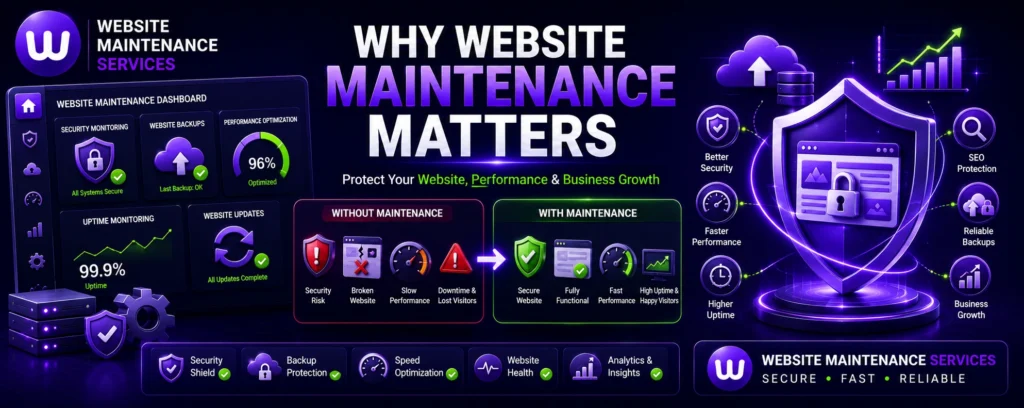
The Importance of Website Maintenance
Your website works 24/7 — but only if you maintain it. This in-depth guide explains why website maintenance is so important, the different types of maintenance, the data that proves it pays off, the warning signs of a neglected site, and the best practices that keep your website secure, fast, and converting all year round.
Quick answer: Website maintenance is important because it keeps your site secure, fast, and online — protecting you from hacks, downtime, lost sales, and falling search rankings. A well-maintained website builds customer trust, ranks higher on Google, converts more visitors, and prevents expensive emergency repairs. In short, maintenance protects both your reputation and your revenue.
What Is Website Maintenance — and Why Does It Matter?
Website maintenance is the ongoing process of keeping a website secure, updated, fast, and fully functional. It includes software and plugin updates, security monitoring, backups, speed optimization, uptime checks, and fixing broken pages or links. Think of it like servicing a car — small, regular attention prevents big, expensive breakdowns.
It matters because your website is often the first — and most important — touchpoint customers have with your business. Studies consistently show that visitors judge a company's credibility within seconds, and most of that judgment is based on design, speed, and whether everything works. A neglected site quietly loses you traffic, leads, and trust, while a maintained one keeps working hard for you around the clock.
That is why website maintenance is not a one-time task but an essential, continuous investment. Search engines, customers, and security threats all evolve constantly — and a website that stands still inevitably falls behind. The importance of website maintenance comes down to one idea: a website is a living asset that needs regular care to keep delivering value.
Why Website Maintenance Is Important: 8 Key Reasons
These are the biggest reasons every business needs ongoing website maintenance.
1. Security
Regular updates and monitoring block malware, hackers, and data breaches before they strike.
2. Speed
Optimization keeps pages loading fast, so visitors stay and convert instead of bouncing.
3. SEO Rankings
Google rewards fast, secure, updated sites and penalizes neglected, broken ones.
4. Uptime
Monitoring catches downtime and errors fast, so your site stays online and selling.
5. User Experience
Working forms, links, and pages keep visitors happy and moving toward a purchase.
6. Brand Trust
A polished, error-free site signals a credible business; a broken one drives customers away.
7. Data Safety
Regular backups mean you can restore your site instantly if anything ever goes wrong.
8. Cost Savings
Preventive care is far cheaper than emergency repairs, malware cleanup, or lost sales.
The 6 Types of Website Maintenance
Website maintenance is not one job — it is six different disciplines working together.
Technical
Core, plugin, and theme updates, bug fixes, code health, and server/hosting checks that keep the site stable.
Security
Malware scanning, firewalls, SSL, login protection, and breach prevention to keep your data and customers safe.
Performance
Speed optimization, caching, image compression, and Core Web Vitals tuning for fast, smooth loading.
Content
Updating text, images, products, and pages so your information stays accurate, fresh, and relevant.
SEO
Fixing broken links, monitoring rankings, optimizing metadata, and keeping technical SEO healthy.
Backup & Recovery
Automated backups and tested restore points so you can recover instantly from any failure or attack.
The Data: Why Maintenance Matters
The numbers make the case for keeping your website maintained.
making it the #1 target for automated attacks — which means outdated plugins are a top cause of hacked sites, according to Sucuri's website hacked reports.
if a page takes longer than 3 seconds to load, per Google's Core Web Vitals research — so speed maintenance directly protects traffic and sales.
Google confirms that speed, security (HTTPS), and stability influence rankings in its page experience guidance — maintenance keeps all three strong.
Visitors judge your site almost instantly, and most of that judgment is visual and performance-based — a broken or slow site loses trust before a word is read.
Figures are widely cited industry findings; confirm exact current numbers with each source before quoting.
How Website Maintenance Drives ROI and Revenue
Website maintenance is often seen as a cost — but it is really a revenue protector and growth driver. Every element of maintenance ties directly to money: faster pages convert more visitors into customers, strong security prevents costly breaches and downtime, and consistent SEO health keeps you visible in search where buyers are looking.
Consider the math. If a single hour of downtime during a busy period costs you a handful of sales, or a slow checkout quietly drops your conversion rate by even 1%, those losses dwarf the price of a monthly maintenance plan. Add the cost of an emergency malware cleanup or a full rebuild after a crash, and proactive maintenance becomes one of the highest-ROI investments a business can make.
In other words, the importance of website maintenance is not just technical — it is financial. A maintained website earns; a neglected one leaks money quietly until something breaks. See real numbers in our website maintenance cost guide.
What Happens If You Neglect Website Maintenance
7 Signs Your Website Needs Maintenance Now
If any of these sound familiar, your site is overdue for attention.
Spotting these early is exactly why a free website audit is worth it.
Website Optimization and Maintenance Go Together
Maintenance keeps your site working; optimization makes it work better. The two go hand in hand. While maintenance handles updates, security, and backups, optimization improves speed, Core Web Vitals, mobile experience, and conversion rates — turning a site that merely functions into one that actively grows your business.
That is why the best plans bundle both: routine upkeep plus ongoing performance and SEO optimization. See our full website maintenance checklist for everything a complete plan should cover.
Website Maintenance Best Practices
Follow these proven practices to keep your website healthy year-round.
Maintain on a schedule
Run updates, scans, and backups on a consistent weekly/monthly cadence — not only when something breaks.
Test on staging first
Apply updates to a staging copy before going live so nothing breaks your real site.
Back up before every change
Always have a recent, tested backup you can restore in minutes if an update goes wrong.
Monitor speed & uptime
Use continuous monitoring so you learn about problems before your customers do.
Remove what you don't use
Delete unused plugins, themes, and bloat — less code means fewer vulnerabilities and faster pages.
Outsource to experts
A professional plan ensures it actually gets done consistently — the #1 reason maintenance fails is simply forgetting.
Maintenance vs a One-Time Redesign
Some businesses skip maintenance and instead rebuild their website every few years. This is far more expensive and risky. A redesign is a large, one-time cost that resets the clock — but without ongoing maintenance, the brand-new site starts degrading the day it launches.
Ongoing maintenance protects your investment so your current site keeps performing for years, often removing the need for premature redesigns altogether. Think of maintenance as protecting the asset you already paid to build — small, steady care instead of huge, occasional rescue projects.
Maintained vs Neglected Website
The difference a maintenance plan makes is clear.
| Area | Maintained Website | Neglected Website |
|---|---|---|
| Security | Protected & monitored | Vulnerable to attacks |
| Speed | Fast, optimized | Slow, high bounce rate |
| SEO | Ranking & growing | Dropping in results |
| Uptime | Online 24/7 | Frequent downtime |
| Backups | Always recoverable | Risk of total data loss |
| Cost | Low, predictable | High emergency repairs |
Why Maintenance Matters by Industry
Every industry depends on its website differently — but all of them depend on it working.
Ecommerce
Downtime or a broken checkout means lost orders instantly. Security and uptime are mission-critical.
Professional Services
Your site is your credibility. Slow or outdated pages cost you high-value leads and trust.
Restaurants & Local
Accurate hours, menus, and fast mobile pages drive bookings and foot traffic.
Healthcare
Security, privacy, and uptime are essential for patient trust and compliance.
Education & Nonprofits
Reliable access and current information keep students, donors, and members engaged.
Startups & SaaS
Performance and reliability shape first impressions with investors, users, and customers.
Who Needs Website Maintenance?
If your business has a website, the answer is you. Maintenance matters for every type of site.
Is your website being neglected?
Get a free website audit — we'll check your site's security, speed, and health, and show you exactly what needs attention. No obligation.
See Website Maintenance in Action
Browse real examples of the websites we keep secure, fast, and online for businesses every day.
View Our WorkFrequently Asked Questions
Common questions about the importance of website maintenance.
Why is website maintenance important?
Website maintenance is important because it keeps your site secure, fast, and online, protecting you from hacks, downtime, lost sales, and falling search rankings. It also builds customer trust, improves SEO, increases conversions, and prevents expensive emergency repairs — protecting both your reputation and your revenue.
What is website maintenance and why is it so important?
Website maintenance is the ongoing process of keeping a website secure, updated, fast, and functional — including updates, security monitoring, backups, and speed optimization. It is so important because your website is your most visible business asset; without maintenance it slowly loses traffic, leads, and trust, and becomes vulnerable to security threats.
What are the types of website maintenance?
The main types are technical maintenance (updates and fixes), security maintenance (malware protection and firewalls), performance maintenance (speed and Core Web Vitals), content maintenance (text, images, and pages), SEO maintenance (links, rankings, and metadata), and backup & recovery. A complete plan covers all six.
What happens if you don't maintain your website?
Without maintenance, websites become slow, vulnerable to malware and hacking, and prone to broken pages and downtime. Search rankings drop, visitors leave, leads are lost, and you risk data loss and expensive emergency repairs — all of which damage your revenue and reputation.
How does website maintenance help SEO?
Search engines favor websites that are fast, secure, mobile-friendly, and free of errors. Maintenance keeps page speed and Core Web Vitals strong, fixes broken links, and ensures uptime — all ranking factors. A maintained site climbs in search results, while a neglected one falls.
How often should a website be maintained?
Core tasks like updates, security scans, and backups should run weekly, with a full health check monthly. Ecommerce and high-traffic sites often need daily attention. Consistency is key — regular small sessions prevent the large, costly problems that come from neglect.
Is website maintenance worth the cost?
Yes. A monthly maintenance plan costs far less than a single emergency repair, malware cleanup, or the lost revenue from downtime. It is a small, predictable investment that protects a much larger asset — your website and the business it drives.
Key Takeaways
- Website maintenance keeps your site secure, fast, online, and ranking.
- It spans six disciplines: technical, security, performance, content, SEO, and backups.
- Neglect leads to hacks, downtime, lost rankings, lost leads, and costly repairs.
- Maintenance is a revenue protector with one of the highest ROIs in business.
- A professional plan ensures it actually gets done — consistently and safely.